

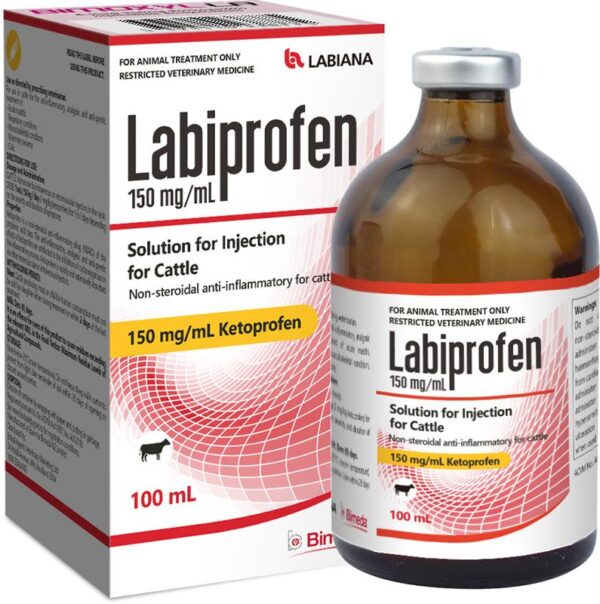
Labiprofen 15% Ketoprofen Injection 100ml
Ketoprofen 15% – Non-steroidal anti-inflammatory for cattle – 100ml bottle
- Description
Description
Active Substance
Ketoprofen 150 mg/mL Solution for injection. A clear colourless to yellowish solution.
Indications for use
– Reduction inflammation and pain associated with post-partum, musculoskeletal disorders and lameness.
– Reduction of fever associated with bovine respiratory disease in combination with antimicrobial therapy where appropriate.
– Reduction of inflammation, fever and pain in acute clinical mastitis in combination with antimicrobial therapy where appropriate.
Amounts to be Administered and Administration route
Cattle: Intramuscular or intravenous use
3mg ketoprofen/kg body weight, i.e., 1mL of product per 50kg body weight/day, administered via the intravenous or intramuscular route, preferably in the neck region.
The duration of treatment is 1 – 3 days and should be established according to the severity and duration of symptoms.
Withdrawal Periods
Cattle:
Meat and offal: 2 days
Milk: zero hours
Contraindications
Do not use in animals where there is the possibility of gastro-intestinal ulceration or bleeding, in order not to aggravate their situation. Do not use in animals suffering from cardiac, hepatic, or renal disease. Do not use in cases of known hypersensitivity to ketoprofen or acetyl-salicylic acid or to any of the excipients. Do not use in animals with evidence of blood dyscrasia or coagulopathy. Do not administer other non-steroidal anti-inflammatory drugs (NSAIDs) concurrently or within 24 hours of each other.
Precautions
Do not exceed the recommended dose.
Do not exceed the recommended treatment period.
When administering to animals of less than 6 weeks of age, or in aged animals it is necessary to adjust the dose accurately as well as to perform a close clinical follow-up.
Avoid Intra-Arterial Injection
Avoid use in any dehydrated, hypovolaemic or hypotensive animals as there is a potential risk of increased renal toxicity.
Since gastric ulceration is a common finding in PMWS (Post-weaning Multisystemic Wasting Syndrome).
Special Precautions to be taken by the person Administering the Veterinary Medicinal Product
Hypersensitivity reactions (skin rash, urticaria) could occur. People with known hypersensitivity to the active substance or to any of the excipients should avoid contact with the veterinary medicinal product. Avoid accidental self-injection. In case of accidental self-injection, seek medical advice immediately and show the package leaf or the label to the physician.
Avoid contact with the skin, eyes and mucous membranes. In case of accidental skin, eye or mucous membrane contact, wash the affected area thoroughly with clean running water immediately.
Seek medical advice if irritation persists. Wash hands after use.
Adverse Reactions
Intramuscular injection of ketoprofen can cause mild, transient, necrotic subclinical muscular lesions that gradually resolve in the days after completion of treatment. Administration in the neck region minimises the extension and severity of these lesions.
Due to the mechanism of action of ketoprofen, after repeated administrations, erosive and ulcerative lesions of the gastrointestinal tract may occur.
In common with all NSAIDs due to their action of inhibition of prostaglandins’ synthesis, there can be the possibility in certain individuals of gastric or renal intolerance.
If side effects occur, treatment must be stopped, and the advice of a veterinarian should be sought.
Use During Pregnancy or Lactation
Pregnancy: Studies in laboratory animals (rats, mice, rabbits) and cattle have not produced any evidence of adverse effects. Can be used in pregnant cows.
Use only accordingly to the benefit-risk assessment by the responsible veterinarian.
Lactation: Can be used in lactating cows.
Interaction with other Medicinal Products
– Concurrent administration of diuretics or potentially nephrotoxic drugs should be avoided since there is an increase of renal disturbances, including renal failure. This is secondary to the diminished blood flow caused by the inhibition of prostaglandins synthesis.
– Do not administer other non-steroidal anti-inflammatory drugs (NSAIDs), corticosteroids, anticoagulants or diuretics concurrently or within 24 hours of administration of the product since the risk of gastrointestinal ulceration and other adverse reactions may be exacerbated.
– The treatment free period should however take into account the pharmacological properties of the products used previously.
– Ketoprofen is highly bound to plasma proteins and may compete with other highly bound drugs which can lead to toxic effects.
Overdose
Overdose with non-steroidal anti-inflammatory drugs can lead to gastro-intestinal ulceration, loss of proteins, hepatic and renal impairment.
The intramuscular administration of the product to cattle, at up to 3 times the recommended dose or for 3 times the recommended duration of the treatment (9 days) did not result in clinical signs of intolerance.
However, inflammation as well as necrotic subclinical lesions were detected at the injection site of the treated animals as well as an increase in CPK levels. The histopathological examination showed erosive or ulcerative abomasal lesions related to both dosage regimes.
If clinical signs of overdose are observed, there is no specific antidote, therefore symptomatic treatment should be initiated.
Pharmacodynamic Properties
Pharmacotherapeutic group: Anti-inflammatory and Antirheumatic Products, Non-Steroids, Propionic acid derivatives. Ketoprofen, 2-(phenyl 3-benzoyl) propionic acid is a non-steroidal anti-inflammatory drug belonging to the arylpropionic acid group. The primary mechanism of action for ketoprofen is considered to be inhibition of the cyclooxygenase pathway of arachidonic acid metabolism, leading to decreased production of inflammatory mediators, such as prostaglandins and thromboxanes. This mechanism of action results in its anti-inflammatory, anti-pyretic and analgesic activity. These properties are also attributed to its inhibiting effect on bradykinin and superoxide anions together with its stabilising action on lysosomal membranes. The anti-inflammatory effect is enhanced by the conversion of the (R)-enantiomer to (S)-enantiomer. It is known that the (S)-enantiomer supports the anti-inflammatory effect of ketoprofen.
Pharmacokinetic Particulars
After intramuscular administration of the product (single dose of 3mg ketoprofen/kg body weight), ketoprofen is rapidly absorbed, and has a high bioavailability.
Ketoprofen binds extensively to plasma proteins (>90%).
The concentrations of Ketoprofen are more sustained in inflammatory exudates than in plasma. It reaches high concentrations and persists in inflamed tissue, due to the fact that Ketoprofen is a weak acid. Ketoprofen is metabolised in the liver 0 inactive metabolites and it is excreted mainly in urine (primarily as glucuroconjugated metabolites) and, to a lesser extent, in faeces.
Small amounts of ketoprofen can be detected in the milk of treated animals.
In cattle, following the intramuscular administration of the product (single dose of 3 mg ketoprofen/kg body weight), the active drug substance is rapidly absorbed, reaching its average Cmax in plasma (mean value: 7.2 µg/mL) between 0.5 and 1 hour (tmax) after initiation of treatment. The fraction of dose absorbed is very high (92.51±10.9%).
Following the intravenous administration in cattle, elimination half-life (t1/2) is of 2.1 h. The distribution volume (Vd) of 0.14 L/kg, and plasma clearance (CƖ) of 0.14 L/h/kg.
Major Incompatibilities
In absence of compatibility studies, this veterinary medicinal product must not be mixed with other veterinary medicinal products.
Shelf-Life
Shelf-life of the veterinary medicinal product as packaged for sale: 30 months.
Shelf-life after first opening the immediate packaging: 28 days.
Special Precautions for Storage
Keep the vial in the outer carton to protect from light.
Special Precautions for the Disposal of Unused Veterinary Medicinal Products
Any unused veterinary medicinal product or waste materials derived from such veterinary medicinal products should be disposed of in accordance with local requirements.
Presentation
Available in 100mL bottle
Registered Animal Remedy
Registered pursuant to the ACVM Act 1997, No. A012118.
Registered to:
Bimeda Animal Health Limited
2, 3 & 4 Airton Road,
Tallaght Dublin
Ireland
Distributed by:
Ethical Agents Veterinary Marketing Ltd
PO Box 97110 Manukau City
Manukau, Auckland 2241
New Zealand
Labiprofen 15% Ketoprofen Injection 100ml
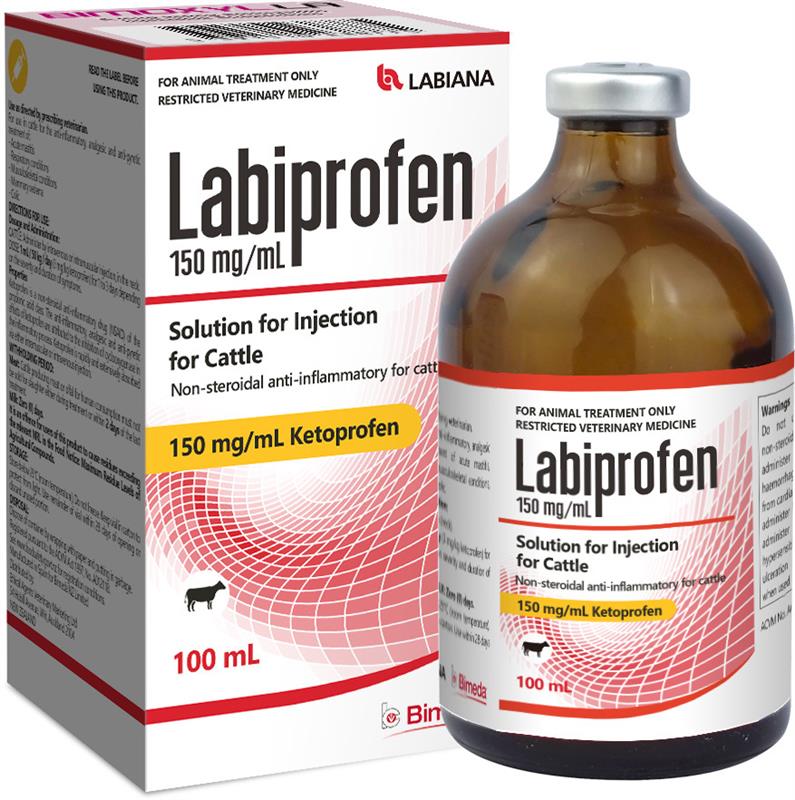
Ketoprofen 15% – Non-steroidal anti-inflammatory for cattle – 100ml bottle